



Twenty-five years after the September 11 attacks, their consequences remain visible in the way we travel, approach security and understand terrorism. Yet even after a quarter of a century, some questions surrounding the attacks have never entirely disappeared.
On the morning of 11 September 2001, New York began an ordinary late-summer Tuesday. The sky was clear. People arrived at their offices, commuters filled the streets and thousands of passengers boarded flights across the United States.
At 8:46 a.m., American Airlines Flight 11 crashed into the North Tower of the World Trade Center. At first, there was confusion. Then, at 9:03 a.m., United Airlines Flight 175 struck the South Tower. The possibility of a terrible accident disappeared. America was under attack.
A third aircraft, American Airlines Flight 77, struck the Pentagon outside Washington, D.C. A fourth, United Airlines Flight 93, crashed into a field near Shanksville, Pennsylvania, after passengers and crew attempted to regain control of the aircraft.
By the end of the morning, both towers of the World Trade Center had collapsed. The attacks killed 2,977 victims and became one of the defining events of the 21st century. Al-Qaeda, led by Osama bin Laden, had successfully carried out a coordinated terrorist operation on American soil.
Twenty-five years later, the footage remains instantly recognisable. But 9/11 is no longer simply something people remember. Increasingly, it is something younger generations know only as history.
And yet much of the world they have grown up in was shaped by what happened that morning.
A world before 9/11
For anyone who has grown up with modern airport security, flying before September 2001 can seem remarkably relaxed.
The 9/11 Commission later found serious weaknesses across the aviation security system. Intelligence, passenger screening, checkpoint security and onboard protection all failed to prevent the 19 hijackers from boarding four aircraft at three airports.
Security procedures that now seem ordinary developed in the aftermath.
The US Congress created the Transportation Security Administration in November 2001, transferring passenger screening at American airports to a new federal security organisation. Cockpit doors were reinforced. Checked baggage screening became significantly more sophisticated. Watchlists, passenger vetting and security technology expanded.
The Department of Homeland Security followed in 2003, bringing 22 different federal agencies and offices under one Cabinet-level department.
For millions of travellers, these institutional changes translated into something much simpler: going through an airport would never feel quite the same again.
The beginning of the War on Terror
The consequences went far beyond airports.
Less than a month after the attacks, the United States and its allies began military operations in Afghanistan. The objective was to destroy al-Qaeda’s infrastructure and remove the Taliban regime that had provided the organisation with sanctuary.
What followed became America’s longest war.
US forces finally withdrew from Afghanistan in August 2021, almost 20 years after the invasion. The Taliban rapidly returned to power.
The wider “War on Terror” also transformed American foreign policy. In 2003, the United States and its allies invaded Iraq and removed Saddam Hussein.
It is important to distinguish the Iraq War from the attacks themselves. Iraq did not carry out 9/11, and the 9/11 Commission found no evidence that contacts between Iraq and al-Qaeda had developed into a collaborative operational relationship.
Nevertheless, 9/11 fundamentally changed the political environment in which the Iraq invasion became possible.
Its consequences would be felt across the Middle East and far beyond for decades.
The day NATO went to war
The impact was also profoundly European.
On 12 September 2001, NATO invoked Article 5, the collective-defence provision of the North Atlantic Treaty. An attack against one member would be considered an attack against them all.
It was unprecedented.
Twenty-five years later, 9/11 remains the first and only occasion in NATO’s history on which Article 5 has been invoked.
European and North American allies subsequently fought alongside one another in Afghanistan. For a generation of European soldiers, diplomats and policymakers, the attacks in New York and Washington reshaped their own countries’ security priorities.
That makes 9/11 more than an American anniversary. Its political consequences became transatlantic almost immediately.
Security versus privacy
There was another transformation taking place less visibly.
Governments wanted to know how an operation involving 19 hijackers had escaped detection—and how the next attack could be prevented.
The answer involved a vast expansion of counterterrorism capabilities.
In the United States, the USA PATRIOT Act gave authorities expanded investigative powers. Intelligence agencies became more integrated, watchlists grew and governments invested heavily in monitoring terrorist networks and financial activity.
Similar debates unfolded across Europe.
The fundamental question was difficult then and remains difficult now: how much privacy should a society surrender in exchange for greater security?
The threat itself also evolved. The years after 9/11 would see attacks in Madrid, London, Paris, Brussels and elsewhere, while organisations including ISIS demonstrated that international terrorism would not disappear with al-Qaeda’s leadership.
Osama bin Laden was killed by US forces in Pakistan in 2011. The security architecture built after the attacks, however, remained.
The questions that never disappeared
There is another part of the 9/11 story that remains controversial 25 years later.
Fifteen of the 19 hijackers were Saudi nationals. Bin Laden himself came from a prominent Saudi family, although Saudi Arabia had revoked his citizenship years before the attacks.
More significantly, questions have persisted about the assistance received by two hijackers after they arrived in the United States.
Nawaf al-Hazmi and Khalid al-Mihdhar arrived in California in 2000 and eventually settled in San Diego. There they encountered Omar al-Bayoumi, a Saudi national who helped them find an apartment and assisted them in establishing themselves in the country.
Was Bayoumi simply helping two fellow Saudis whom he happened to meet? Or was there more to the relationship?
The question would occupy investigators for years.
The 9/11 Commission’s 2004 report concluded that it had found no evidence that the Saudi government as an institution or senior Saudi officials individually funded al-Qaeda. It also found no evidence that any foreign government or foreign government official supplied funding to the 19 hijackers.
That remains an important finding.
But it was not the end of the story.
The Saudi Arabia controversy
Part of the suspicion was intensified by 28 pages of a congressional inquiry concerning possible Saudi connections that remained classified for years.
Their secrecy inevitably encouraged conspiracy theories.
When the pages were eventually declassified in 2016, they did not contain proof that the Saudi government had organised the attacks. They did, however, reveal why investigators had examined possible connections between Saudi-linked individuals and some of the hijackers.
The FBI subsequently continued investigating whether a support network had existed around Hazmi and Mihdhar. Its investigation, known as Operation Encore, examined Bayoumi and others with links to Saudi institutions.
More information has emerged through a long-running civil lawsuit brought by 9/11 victims and their families against Saudi Arabia.
In August 2025, that litigation reached an important point.
US District Judge George B. Daniels rejected Saudi Arabia’s attempt to have the lawsuit dismissed. After reviewing evidence gathered during years of litigation, the judge concluded that the plaintiffs had presented enough evidence relating to Bayoumi and Saudi diplomat Fahad al-Thumairy for the case to continue.
This needs to be interpreted carefully. The ruling did not establish that Saudi Arabia planned 9/11. It did not find the Saudi government legally responsible for the attacks. Saudi Arabia strongly disputes the allegations. It means that the evidence was sufficient for the victims’ claims to proceed rather than be thrown out at that stage.
Twenty-five years after the attacks, therefore, the narrower question of whether people connected to Saudi institutions knowingly assisted two of the hijackers remains contested.
Did the Bush administration cover something up?
The close relationship between the United States and Saudi Arabia has also fueled a more dramatic allegation: that President George W. Bush’s administration protected the Saudis after 9/11.
One story has proved particularly persistent.
In the days after the attacks, Saudi citizens, including members of the extended bin Laden family—left the United States on chartered aircraft. Over time, this developed into claims that politically connected Saudis had been secretly allowed to escape while American airspace remained closed.
The 9/11 Commission investigated the allegation.
It found no evidence that flights carrying Saudi nationals departed before US airspace reopened on 13 September. It also found no evidence of political intervention by senior White House officials to facilitate the departures and concluded that the FBI had screened the Saudi passengers.
That does not make every question about America’s relationship with Saudi Arabia illegitimate.
Relevant documents remained classified for years. The depth of the FBI’s later investigations was not initially known publicly. And the continuing lawsuit demonstrates that questions about certain Saudi-linked individuals have not simply vanished.
But there is an important difference between questioning whether governments disclosed everything they knew and claiming that President Bush knew Saudi Arabia was responsible for 9/11 and deliberately concealed it.
The publicly established evidence does not prove the latter.
25 years later
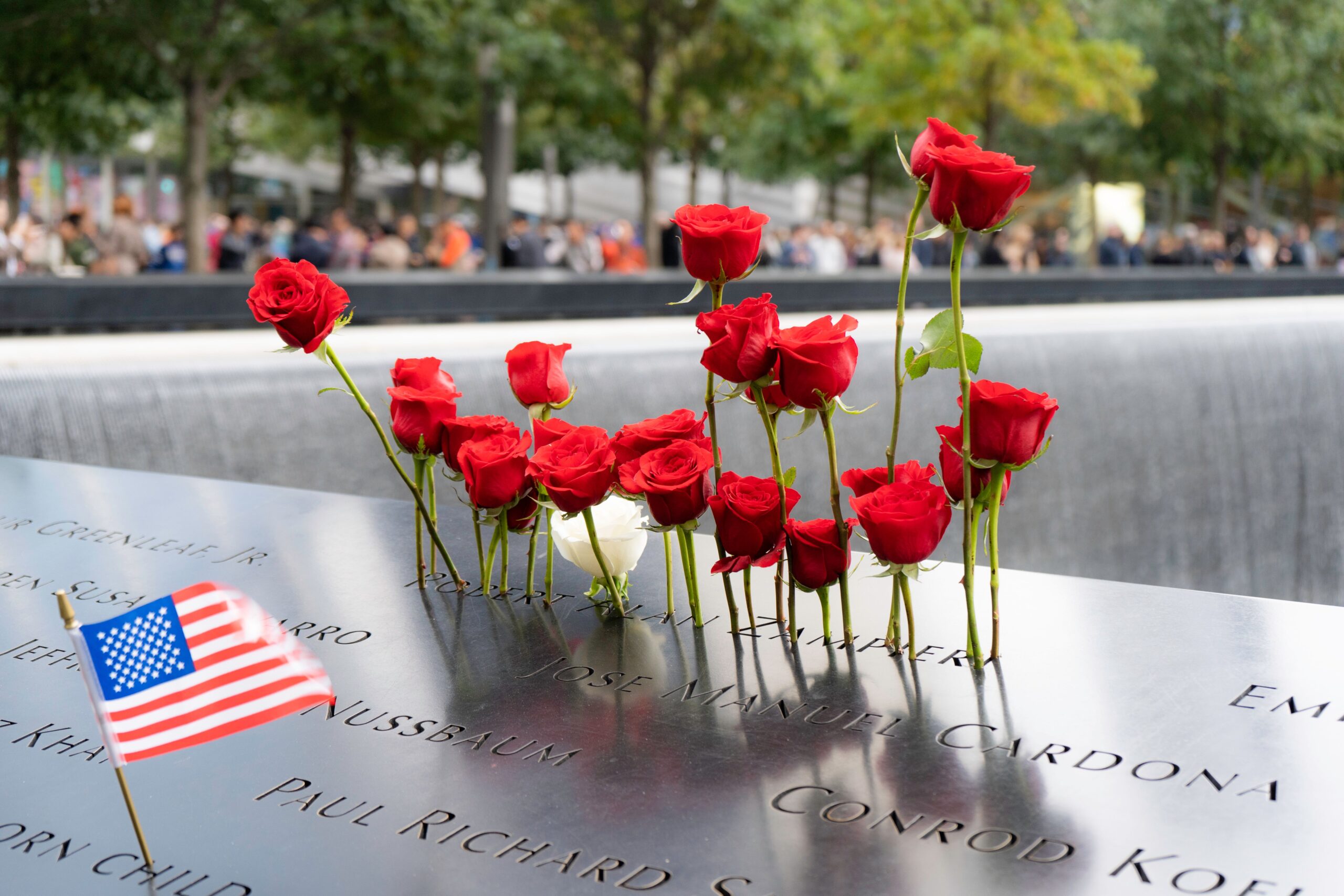
Today, families of those killed on 9/11 are gathering once again at the Memorial plaza in Lower Manhattan.
At the 25th-anniversary ceremony, relatives are reading the names of those who died. Moments of silence mark the times the towers were struck and collapsed, the attack on the Pentagon and the crash of Flight 93.
This year, organisers have added a seventh moment of silence to honour those who have subsequently died from illnesses associated with exposure to the aftermath of 9/11.
It is a reminder that the human consequences did not end when the ruins of the World Trade Center were cleared.
But something else has changed. Someone born on 11 September 2001 turns 25 today.
For that generation, there is no memory of watching the second aircraft hit the South Tower live on television. No memory of the uncertainty that followed, of offices and schools gathering around television screens or of people repeatedly trying to reach relatives by telephone.
They inherited the consequences rather than the memory.
Airport security, counterterrorism operations, the wars in Afghanistan and Iraq, surveillance debates and an altered relationship between security and personal freedom were already part of their world.
For those old enough to remember the attacks, however, 25 years can feel surprisingly short.
They remember where they were. They remember who told them. They remember the images. Perhaps that is what makes this anniversary different.
September 11 is beginning to move from lived experience into history, while many of the political and social changes it produced remain firmly part of the present.
The attacks themselves lasted less than two hours. The world they created has lasted a quarter of a century, and counting.
Further Reading
What are The Benefits of Meditation
Stay Connected
Subscribe to the Together Magazine newsletter for thoughtful features, personal development insights, cultural recommendations, museum exhibitions, events in Brussels and Belgium, and the latest stories delivered directly to your inbox.