



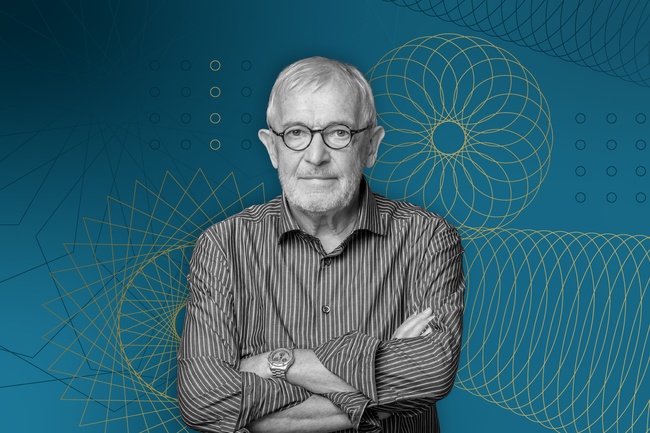
Francis Halzen has won the 2026 Nobel Prize in Physics, bringing a remarkable Belgian scientific story into the international spotlight. The Belgian-born professor at the University of Wisconsin–Madison helped turn Antarctic ice into an observatory for some of the universe’s most elusive particles.
From Belgium to the South Pole
Born in Tienen in 1944, Halzen studied at KU Leuven before building his career in the United States. His work connects a Belgian education with an international scientific undertaking far beyond the usual image of a university laboratory.
The Nobel recognition honours his decisive role in IceCube and the discovery of high-energy neutrinos from astrophysical sources. It is a story of persistence as well as intellectual ambition: an idea that required researchers to look beneath the ice rather than towards the sky.
A telescope beneath the ice
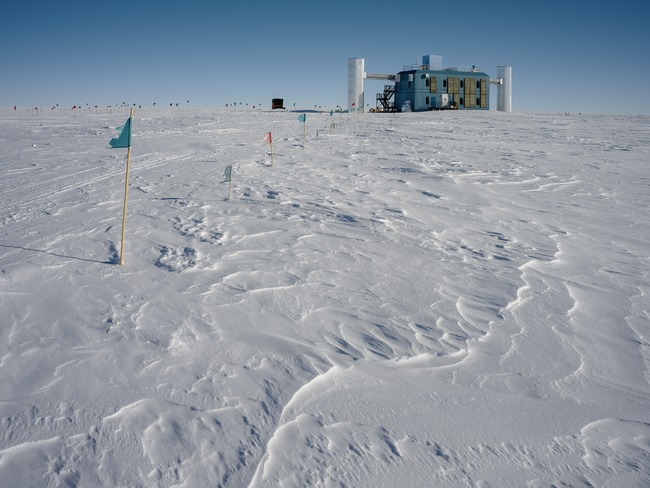
IceCube is based at the South Pole, with 5,160 optical sensors installed in deep Antarctic ice. Unlike a conventional telescope, it does not gather starlight through a lens or mirror.
Instead, the instruments register the faint light produced by charged particles following rare neutrino interactions. Those signals help researchers reconstruct the direction and energy of particles arriving from space.
Neutrinos interact only weakly with matter, which makes them extraordinarily difficult to detect. The vast volume of ice is therefore essential to the experiment, providing a medium large enough to catch events that a smaller detector would miss.
Why these particles matter
Light remains central to astronomy, but it does not tell the whole story. High-energy neutrinos offer another way to investigate distant environments and the processes capable of accelerating particles to immense energies.
That is the wider significance of Halzen’s work. It has helped establish neutrino astronomy, giving scientists a new messenger with which to explore the cosmos alongside more familiar observations.
A Belgian story with an international reach
IceCube’s success depends on an international collaboration, sophisticated engineering and years of observation. The Nobel award recognises an individual contribution within that collective achievement.
For readers in Belgium, the news offers a welcome opportunity to discover a scientist whose career may be less familiar than his country’s cultural exports. His work is also a reminder that discovery can begin with an unconventional question: what if the clearest view of space lay inside the ice?
Further information
Nobel Prize: 2026 Physics award
Nobel Prize: Francis Halzen facts