




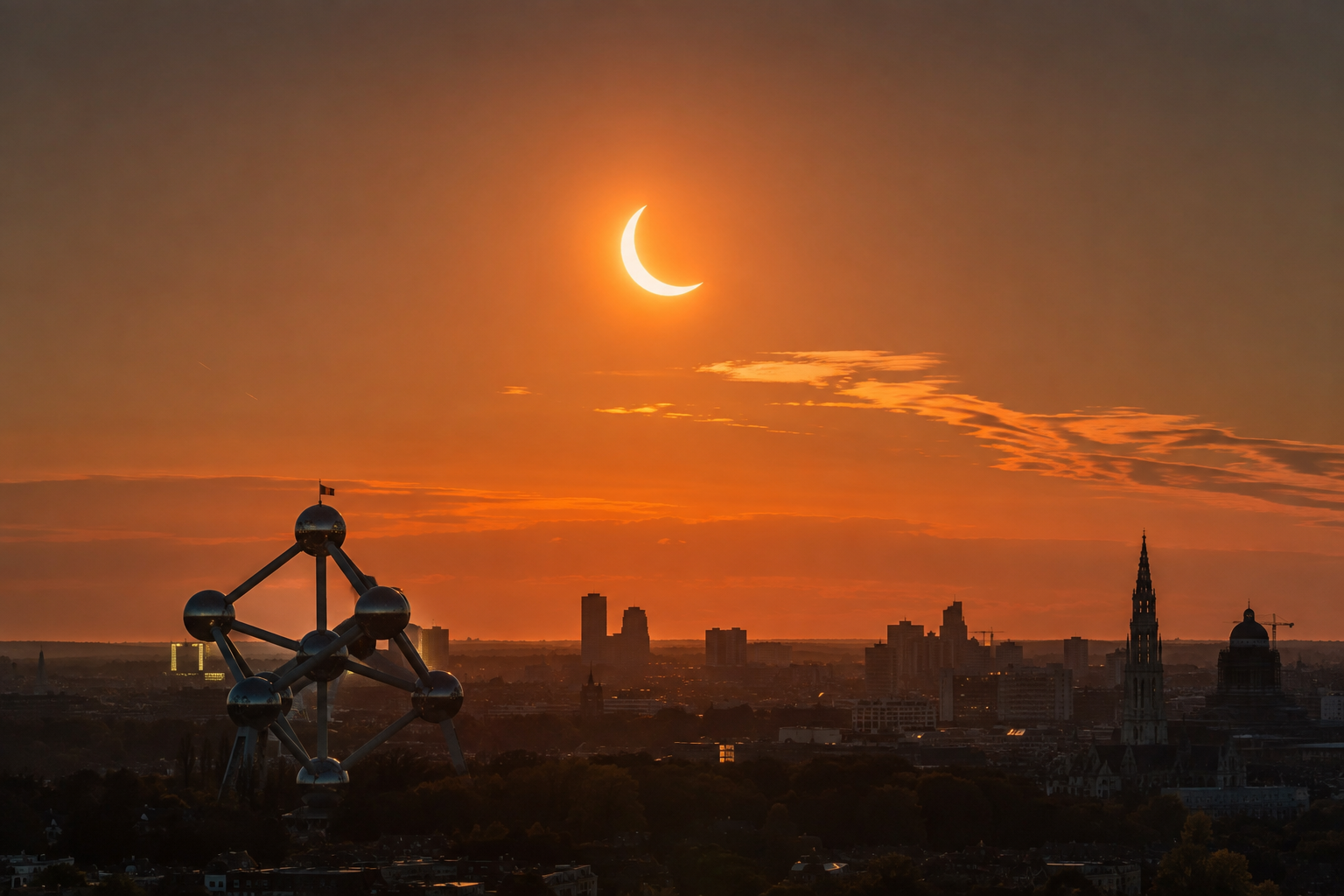
Belgium is about to witness one of the most spectacular astronomical events of the decade. On Wednesday, 12 August 2026, a major solar eclipse will sweep across Europe, with the Moon passing directly between the Earth and the Sun and transforming the early evening sky.
While Belgium lies just outside the narrow path of totality, the eclipse here will still be remarkably impressive. In Brussels, around 89.5% of the Sun will be obscured at the peak of the eclipse, making this an event well worth stepping outside to see.
For anyone in Brussels, the key time to remember is 8:13pm.
The partial eclipse will begin at approximately 7:18pm, when the Moon will appear to take its first small “bite” out of the Sun. Over the following hour, more and more of the solar disc will disappear. Maximum eclipse in Brussels occurs at approximately 8:13pm, when close to 90% of the Sun will be covered. The partial eclipse then gradually ends at around 9:05pm.
Conditions will be particularly atmospheric because the eclipse takes place during the evening, with the Sun already moving lower towards the western horizon.
The phenomenon will be visible across Belgium. Antwerp will experience approximately 89.2% obscuration, Bruges around 89.8%, Ghent around 89.7%, Charleroi around 89.8%, Namur around 89.6% and Liège around 89.1%.
Where Will the Eclipse Be Total?
Travel a little farther south and the experience becomes even more dramatic.
The path of totality on 12 August will cross parts of Greenland, Iceland, northern Russia, Spain and a small section of Portugal. Inside this narrow corridor, the Moon will completely cover the Sun, briefly turning day into twilight and revealing the Sun’s normally invisible outer atmosphere, known as the corona.
Spain is expected to be one of Europe’s prime viewing destinations.
Cities including León, Zaragoza and Valencia lie within the path of totality. In León, for example, totality begins at approximately 8:28pm and lasts for around two minutes. Valencia will experience totality at around 8:32pm, shortly before sunset.
Even cities outside the totality zone will experience an extraordinary eclipse. Barcelona and Madrid will see around 99% of the Sun obscured, while Paris will see approximately 92%, London 91% and Dublin 94%.
For travellers lucky enough to be in northern Spain, the combination of a total solar eclipse and sunset could produce one of the most memorable celestial spectacles Europe has seen in years.
What Actually Causes a Solar Eclipse?
A solar eclipse occurs when the Moon passes between Earth and the Sun at precisely the right alignment.
Although the Sun is enormously larger than the Moon, an extraordinary coincidence makes total solar eclipses possible: the Sun is roughly 400 times larger than the Moon but is also approximately 400 times farther away from Earth. From our perspective, therefore, the two objects appear almost exactly the same size in the sky.
When the alignment is perfect, the Moon can completely cover the brilliant surface of the Sun.
Those standing within the Moon’s central shadow — known as the umbra — experience a total eclipse. People farther away, within the wider penumbra, experience a partial eclipse. Belgium falls within this partial-eclipse zone on 12 August.
Scientists Will Be Watching Too
The eclipse isn’t simply a spectacular sight. It also provides scientists with a rare natural laboratory.
NASA-funded teams will use a high-altitude aircraft and scientific balloons during the eclipse to study the Sun and Earth’s atmosphere. Scientists are particularly interested in observing the solar corona and investigating how the sudden reduction in sunlight affects the lower atmosphere.
During totality, the intensely bright surface of the Sun disappears behind the Moon, allowing scientists to observe the much fainter corona in ways that are normally impossible from Earth.
How to Watch the Eclipse Safely
There is one extremely important rule for anyone planning to watch tomorrow’s eclipse:
Never look directly at the Sun without proper solar eye protection.
Ordinary sunglasses are not sufficient, regardless of how dark they are.
Use certified eclipse glasses or a proper handheld solar viewer designed specifically for observing the Sun. Cameras, binoculars and telescopes also require appropriate solar filters. Looking at the Sun through an optical device without the correct filter can cause serious eye damage.
And remember: Belgium will experience a partial eclipse, not totality, so there is no moment during tomorrow’s eclipse when it becomes safe to look directly at the Sun without protection.
When to Look Up in Brussels
If the weather cooperates, find somewhere with an unobstructed view towards the western sky tomorrow evening.
The eclipse begins at around 7:18pm, but the moment to put in your diary is 8:13pm, when approximately 89.5% of the Sun will be obscured over Brussels.
At that point, the Sun will have been reduced to a brilliant crescent.
Almost one billion people worldwide are expected to be geographically positioned to see at least some part of the eclipse, but only around 15 million live within the much narrower area experiencing totality.
For those of us staying in Belgium, however, there is no need to feel left out.
With almost 90% of the Sun disappearing over Brussels during an August evening, 12 August 2026 promises to deliver one of Belgium’s most memorable skies of the year.
So find your eclipse glasses, hope for clear skies — and at 8:13pm tomorrow, look west.