




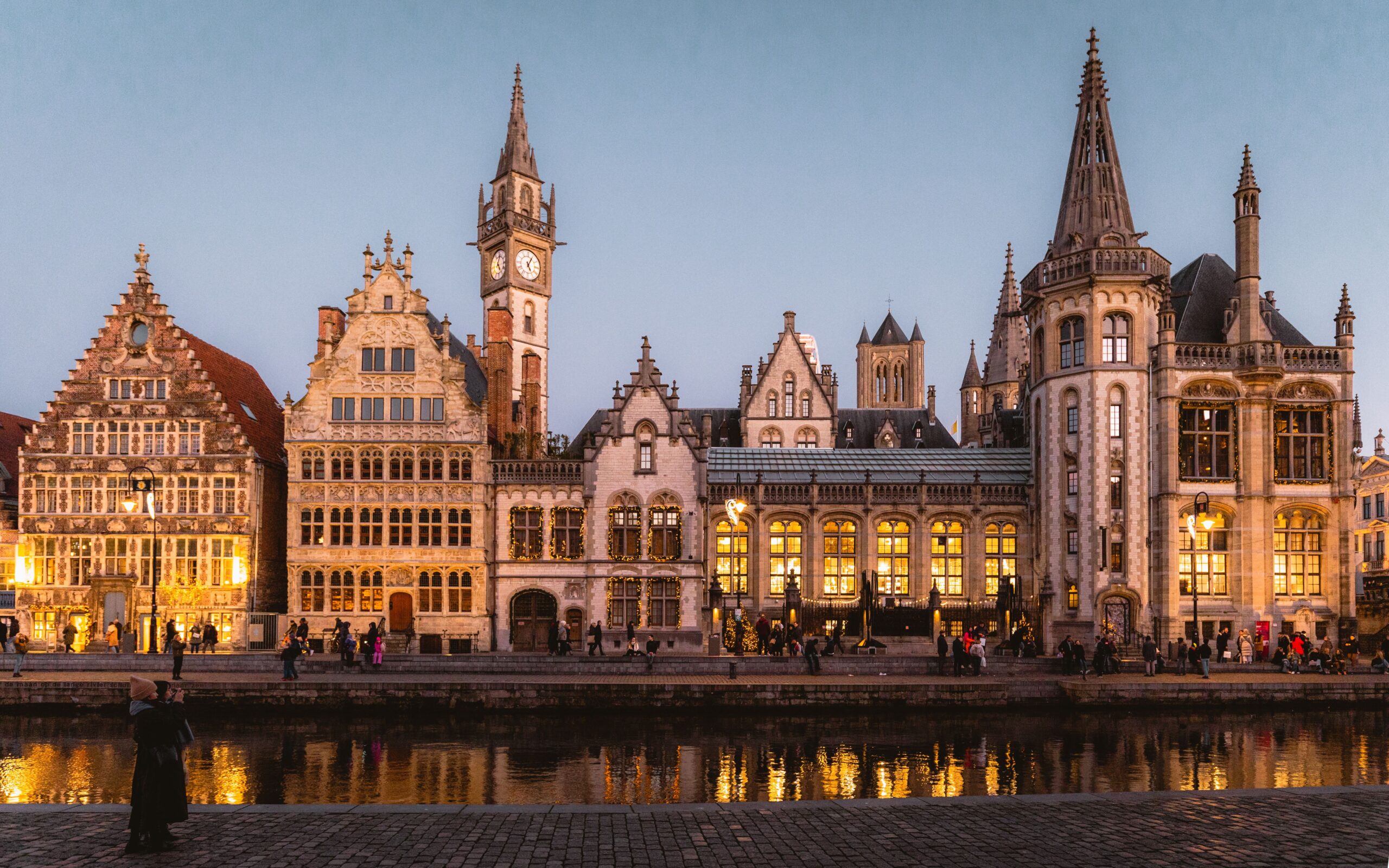
From medieval canals and a world-famous masterpiece to student life, exceptional food and one of Belgium’s most atmospheric city centres, Ghent is having its moment.
For years, Ghent was the Belgian city that many international visitors seemed to overlook. Bruges had its romantic canals and medieval streets, Brussels had its grand squares and international reputation, and Antwerp had fashion, diamonds and design. Ghent was often treated as the quieter option in between.
That is increasingly changing. Over the past few years, Ghent has attracted growing attention from international travellers and travel publications, with the city increasingly recognised as a destination in its own right rather than simply a stop between Brussels and Bruges. Vogue, for example, recently described Ghent as a cultural and creative alternative to Belgium’s better-known cities, highlighting its combination of medieval architecture, student energy, cafés, food and contemporary culture.
The timing is hardly surprising. Belgium recorded a record 46.1 million overnight stays in 2025, while international overnight stays increased by 4%. Ghent fits neatly into the kind of European city break that is becoming increasingly attractive: compact, walkable, culturally rich and close enough to reach easily from other major European cities.
But the real reason to visit Ghent is simpler. It is a city where the past and present coexist unusually well.
A Medieval City That Still Feels Alive
The first impression is undeniably historic.
Walk towards the Graslei and Korenlei and you are confronted with one of Belgium’s most beautiful urban scenes: rows of historic buildings reflected in the River Lys, narrow streets disappearing into the old centre and medieval towers rising above the rooftops.
The architecture is spectacular, but what makes the setting particularly appealing is that it isn’t simply preserved for tourists. The waterfront is also a place where people actually live their lives. Locals meet friends at cafés, students sit beside the water, cyclists pass through the historic centre and restaurants spill onto the streets.
Ghent’s tourism authorities describe the city as a “cultural cocktail on a human scale”, and that is perhaps its greatest advantage. Most of the major sights are within walking distance, allowing visitors to experience the historic centre without spending their weekend constantly moving between attractions.
 See Ghent From the Water
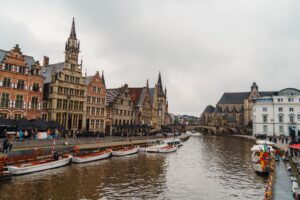
There is perhaps no better way to appreciate the city’s architecture than from the water.
Ghent is shaped by the Lys, the Scheldt and a network of smaller canals, and the waterways have played an important role in the city’s history and identity. Today, they offer one of the most enjoyable ways to experience the city.
Boat tours take visitors beneath bridges and past medieval façades, historic warehouses and some of Ghent’s most recognisable landmarks. Guided tours are available in several languages, while visitors who prefer a more independent experience can even rent a boat themselves. (Visit Gent)
From the water, the city looks different. The famous buildings along the Graslei and Korenlei appear almost theatrical, while the pace of the journey encourages you to slow down and simply take in the architecture.
For a city break, it is one of those experiences that feels both touristy and completely worthwhile.
A Masterpiece Hidden Inside St Bavo’s Cathedral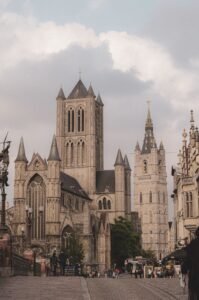
Then there is the painting that alone makes Ghent worth the journey.
Inside St Bavo’s Cathedral hangs The Adoration of the Mystic Lamb, better known as the Ghent Altarpiece, the extraordinary 15th-century masterpiece created by the Van Eyck brothers.
The twelve-panel work is considered one of the defining masterpieces of Northern European art. Its history is almost as remarkable as the painting itself: it has survived wars, theft, political upheaval and centuries of changing attitudes towards art.
Today, restored panels can be seen at the cathedral’s visitor centre, while the remaining restoration work is being carried out by specialists at the Museum of Fine Arts in Ghent. (Visit Gent)
For visitors who have come primarily for the city’s architecture and atmosphere, the Altarpiece provides a reminder that Ghent is also an important European cultural destination.
It is difficult to stand in front of the work and not appreciate the extraordinary artistic ambition behind it.
The Castle in the Middle of the City
Few European cities can claim to have a genuine medieval castle sitting directly in the middle of the urban centre.
Ghent can.
The Castle of the Counts, or Gravensteen, dates back to the 12th century and was built by Philip of Alsace. Its imposing stone walls, towers and moat make it one of the city’s most instantly recognisable landmarks.
It also has a rather colourful history. The castle served as the residence of the Counts of Flanders before later becoming a courthouse, prison, mint and cotton factory. Today it is one of Ghent’s most popular attractions, allowing visitors to explore its rooms, towers and defensive structures while learning about the city’s medieval past. (Visit Gent)
The castle’s location is part of its appeal. You do not need to travel into the countryside to find it. It rises directly from the historic centre, surrounded by cafés, restaurants and the city’s busy streets.
It is history integrated into everyday urban life.
A City Powered by Students
Perhaps the biggest difference between Ghent and some of Belgium’s more traditional tourist destinations is the energy created by its student population.
Ghent is one of Belgium’s major university cities, and students account for a significant proportion of its population. Their presence has helped create a city that feels considerably younger than its medieval architecture might suggest.
That energy is visible everywhere. Cafés stay busy, cycling is deeply embedded in everyday life, bars fill in the evenings and independent businesses give neighbourhoods a distinctly contemporary character.
The result is an unusual combination: you can spend the afternoon exploring a 12th-century castle and then find yourself surrounded by students drinking beer beside the Lys a few minutes later.
That contrast is one of the reasons Ghent feels less like a historic attraction and more like a living city.
And Then There Is the Food
Ghent’s food scene has become another important part of its appeal.
The city combines traditional Flemish cooking with a younger, more international restaurant culture. Classic dishes such as waterzooi and other regional specialities remain part of the experience, but visitors will also find creative restaurants, independent cafés, international cuisine and a particularly strong plant-based scene.
Ghent has developed a reputation for vegetarian dining, and its food culture increasingly reflects the city’s progressive personality. The official tourism organisation highlights everything from trendy restaurants and cafés to sustainable food concepts, while international coverage has also singled out the city’s plant-forward dining scene. (Visit Gent)
For visitors, this means that eating in Ghent doesn’t have to be an afterthought between sightseeing stops. The restaurants are part of the experience.
And then there is Belgian beer.
From traditional brown cafés to modern bars and specialist beer establishments, Ghent provides plenty of opportunities to explore Belgium’s brewing culture. The city’s food and drink scene is particularly well suited to the kind of traveller who prefers to discover a destination slowly, one meal, coffee or beer at a time.
Why Ghent Now?
Perhaps the most interesting thing about Ghent’s growing popularity is that the city hasn’t suddenly become something new.
The castle was always there. The canals were always there. The Altarpiece has been attracting scholars and art lovers for centuries. The medieval centre hasn’t appeared overnight.
What has changed is the way travellers are looking at European cities.
After years in which visitors concentrated on Europe’s most famous destinations, there is growing interest in places that offer authenticity without sacrificing culture, food or atmosphere. Ghent fits that mood almost perfectly.
Ghent has the visual beauty of a classic European city but the energy of a university town. It offers major works of art without requiring visitors to spend their entire weekend in museums. It has canals and medieval buildings, but also independent restaurants, contemporary culture and a lively nightlife.
And unlike destinations that can feel overwhelmed by tourism, Ghent still feels like a city first and a tourist attraction second.
That may ultimately be its greatest advantage.
Ghent doesn’t need to compete with Bruges. It offers something different.
It is a city to wander rather than rush through, to experience from the water as well as the streets, to discover through its food and cafés as much as its museums and monuments. For travellers looking for a Belgian city break that combines history with a distinctly modern personality, Ghent is increasingly difficult to overlook. (Visit Gent)
Further Reading
The Best Terrace Restaurants in Brussels
Stay Connected
Subscribe to the Together Magazine newsletter for thoughtful features, personal development insights, cultural recommendations, museum exhibitions, events in Brussels and Belgium, and the latest stories delivered directly to your inbox.