








A former head of the European Parliament’s media operation is himself in the news after taking on a key new role.
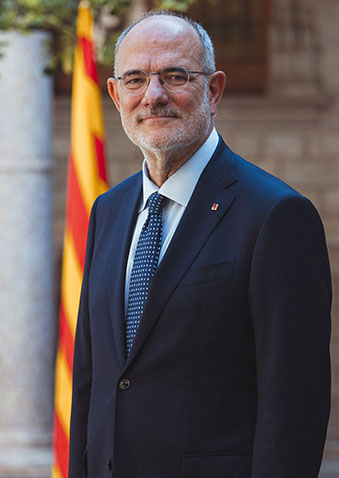
For years, Jaume Duch Guillot sought to promote the work of the parliament, sometimes to a sceptical audience.
He has now been elected to help promote awareness of the body that represents some of Europe’s outermost areas, the Conference of Peripheral Maritime Regions (CPMR).
Its members elected Jaume Duch to the key position of the organisation’s president at its general assembly last week.
The Spaniard told this site one of his tasks will be to raise awareness of the “very important” work undertaken by the CMPR, based in Rennes, France.
He also aims to draw on his previous long spell at the EU parliament’s chief spokesman to to make EU citizens “better aware” of the CPMR and its work.
He said, “I worked for a long time in the EU parliament and, knowing the EU institutions and how they work, will help in this regard.”
His election is timely as it comes as the EU is finalising its next long-term budget. Europe’s regions are fearful of financial cuts in the coming years that, they say, would seriously impact on their work.
Jaume Duch, currently Minister for European Union and External Action of the Government of Catalonia, will serve as the CPMR’s new President for the 2026–2028 mandate.
His election marks the beginning of a new political term for the organisation at a decisive moment for the future of European policies. He succeeds Filip Reinhag of Region Gotland (Sweden), who has led the CPMR since October 2024.
Jaume Duch started his career within the Parliament administration as an official in 1990, prior to which he was an assistant to an MEP. He held the post of Media Director and spokesman for the European Parliament from 2006 and,in 2017, was appointed the parliament’s Director General of Communication of the European Parliament, a role he combined with being the spokesman.
In 2014 he received the “Best Spokesperson Award”, awarded by the Catalan Journalists’ Association and, two years later, was voted “Distinguished Spanish personality in communication that has promoted the European project.”
Speaking at the AGM, its 54th, in Stavanger, Norway, he said the CPMR, which represents more than 100 regional authorities from 21 countries across Europe and beyond, had grown to be “one of the most important” regional organisations and networks.
“There is a big role for regions and now,” he told the assembly, “is the time to demonstrate our political strength.”
Organised in 6 geographical commissions, he said the CPMR will continue to ensure that a “balanced territorial development” is at the heart of the European Union and its policies.
His first major challenge is the 2028-2034 Multiannual Financial Framework (MFF).
After three months of in-depth engagements on the MFF, the Irish Presidency last month presented its revised compromise proposal – Negotiating Box – on the future EU budget.
Some say the plan reduced the budget relative to GNI and falls short of Europe’s investment needs.
MEPs have called for higher funding and criticized cuts below the EU Commission’s proposal. The Irish Presidency says its proposal reflects an ambitious budget of €1.62 trillion, a 30% increase from the current MFF. EU council president Antonio Costa has called for efforts to continue to reach agreement by the end of the year.
Jaume Duch told the AGM, attended by about 200 delegates, his election was “timely” as it comes amid fierce debate about the EU budget, saying the CMPR’s role will be to “present a coordinated approach” in the ongoing negotiations.
He said there were “legitimate concerns” about the budget but was “confident” the CMPR’s voice “will be heard.”
Generally, he said his presidency will be based on “dialogue, cooperation and results,” adding, “I will approach the mandate with openness and I want to assure the regions that their concerns will be taken seriously.”
He said his aim is to look back in two years’ time and say that his term at the helm of the CPMR “made a difference.”
Another objective, he told this site, will be to “reinforce” ties with the Committee of the Regions,adding, “We both have different functions but we also compliment each other.”
After he left the EU parliament in 2024 Barcelona-born Jaume Duch returned to domestic politics and his native Catalonia which has been a member of the CPMR since 1990, playing an active role in the organisation and its Inter mediterranean Commission.
With a longstanding commitment to European cooperation, a CPMR spokesman said Catalonia takes on the presidency role “with the ambition of strengthening the voice of peripheral and maritime regions and their influence on Europe’s future.”
Presenting his vision and priorities for the organisation, the newly-elected president outlined his ambition to “strengthen the collective voice” of Europe’s peripheral and maritime regions and their influence on European decision-making.
“The CPMR’s strength lies in the diversity of its member regions and their ability to turn shared territorial experiences into a stronger political voice in Europe,” Jaume Duch stated.
During his two-year mandate, he says he will focus on defending a “strong” cohesion policy and a “place-based” EU budget, placing maritime regions “at the heart of Europe’s competitiveness and resilience agendas, and ensuring that European policies reflect the specific needs of all territories.”
He will also seek to strengthen the role of regions in European decision-making, advance territorial cooperation and diplomacy, and promote a more cohesive, competitive and resilient Europe in which no region is left behind.
His says his overarching ambition is to “translate the collective strength of the CPMR’s members into tangible results” for Europe’s regions.
“Europe is changing, and so is the world. Our regions are already part of that change. This moment also calls on us, as regions, to take responsibility and help shape the Europe that emerges,” he declared.
Under his mandate, he told delegates who convened for the annual big get-together that Europe’s eastern borders faced “exceptional challenges” and that their concerns “must be understood.”
He said that while the CPMR is not a defence organisation, when it comes to security regions can contribute and still have a role to play.
“In an uncertain world like this cooperation between territories can bring major understanding. The CPMR has a lot of experience and has shown it can interact well with the EU institutions.”
Last week’s AGM in Stavanger brought together member regions and high-level representatives of European institutions, including MEPs and Commission representatives. Across three thematic sessions, participants discussed the role of regions in strengthening Europe’s territorial diplomacy, resilience, competitiveness and security; the need for a future EU budget that reflects Europe’s territorial diversity; and the contribution of regions to the energy transition, particularly in peripheral territories.
A CPMR spokesman told this site, “These exchanges reaffirmed the CPMR’s commitment to ensuring that regional perspectives are fully reflected in European policies and help set the political direction for the organisation’s work in the years ahead.”