








The 12th EPP European Congress of Young Farmers was held at the European Parliament in Brussels under the theme “#ReFarmEU: Ensuring a Future for Our Farmers”.
Hosted on Wednesday by MEPs Herbert Dorfmann (Italy), Carmen Crespo Díaz (Spain), Paulo do Nascimento Cabral (Portugal) and Maria Walsh (Ireland), the Congress brought together more than 500 participants at the European Parliament and over 1,000 participants following the event online, alongside 30 MEP Ambassadors from 17 countries.
Nine young farmers from nine Member States presented their projects, competing for three awards.
“The future of European agriculture depends on bringing new generations into farming. We must give young farmers the confidence and the means to succeed, with fair and stable incomes. The EPP is fighting for a strong, well-funded CAP that supports young farmers, boosts farm profitability and investment, and continues to support rural areas and farmers facing geographical challenges. Generational renewal is not just an agricultural priority – it is an investment in Europe’s food security, competitiveness, and the vitality of rural areas.” said MEPs Herbert Dorfmann, Carmen Crespo Díaz, Paulo do Nascimento Cabral and Maria Walsh today at the opening of the 12th EPP European Congress of Young Farmers.
Launched in 2012 by the EPP Group, the Portuguese Farmers Confederation (CAP) and the Spanish Farmers Association (ASAJA), the event has become a landmark in the agricultural calendar, giving young farmers a voice in the European Parliament.
“Europe’s agricultural future depends on its ability to empower the next generation of farmers. We must create the right conditions for young people to enter the sector, develop competitive businesses and pursue a rewarding future in farming. Supporting young farmers means securing Europe’s food production, rural vitality and long-term resilience”, said Álvaro Mendonça e Moura, President of CAP.
“If the EU is serious about generational renewal, it must stop focusing on rhetoric and start focusing on the conditions that keep young farmers on the land: profitability, water, production tools and affordable inputs. Without farm income, CAP percentages are irrelevant. Without irrigation, young farmers struggle to survive beyond the first years. Without access to active substances, fertilisers and affordable energy, European agriculture cannot remain competitive. Generational renewal will not be achieved by subsidies alone, but by ensuring that farming remains a viable business.”, said José María Castilla Baró, General Director of ASAJA
MEP Maria Walsh, rapporteur on generational renewal, opened the debate together with content creator Klaas mit K, where the debate focused on why generational renewal matters for Europe’s Farmers.
This year’s edition of the Congress also welcomed Finnish Minister of Agriculture and Forestry Sari Essayah, European Commissioner for Environment Jessika Roswall, MEP Norbert Lins and CEJA President Peter Meedendorp, together and with questions from the young farmers the discussion was focused on how to turn vision into action.
Marking the International Year of the Woman Farmer 2026, a dedicated session with Mairead McGuinness, the EPP Vice-President and the President of EPP Women, and Mariana Pereira, a young farmer from Portugal, the role of women in European agriculture was properly highlighted.
The winners were Tamás and Dániel Kránicz from Hungary, Bernardo Vieira e Brito, from Portugal, and Christian Rabensteiner, from Italy.
Winners were selected by the congress jury (80%) composed by MEP Daniel Buda, Maxi Espeter, Jurgen Tack, Elli Tsiforou and Séamus Boland. The remaining 20% were decided by a live public vote during the Congress.
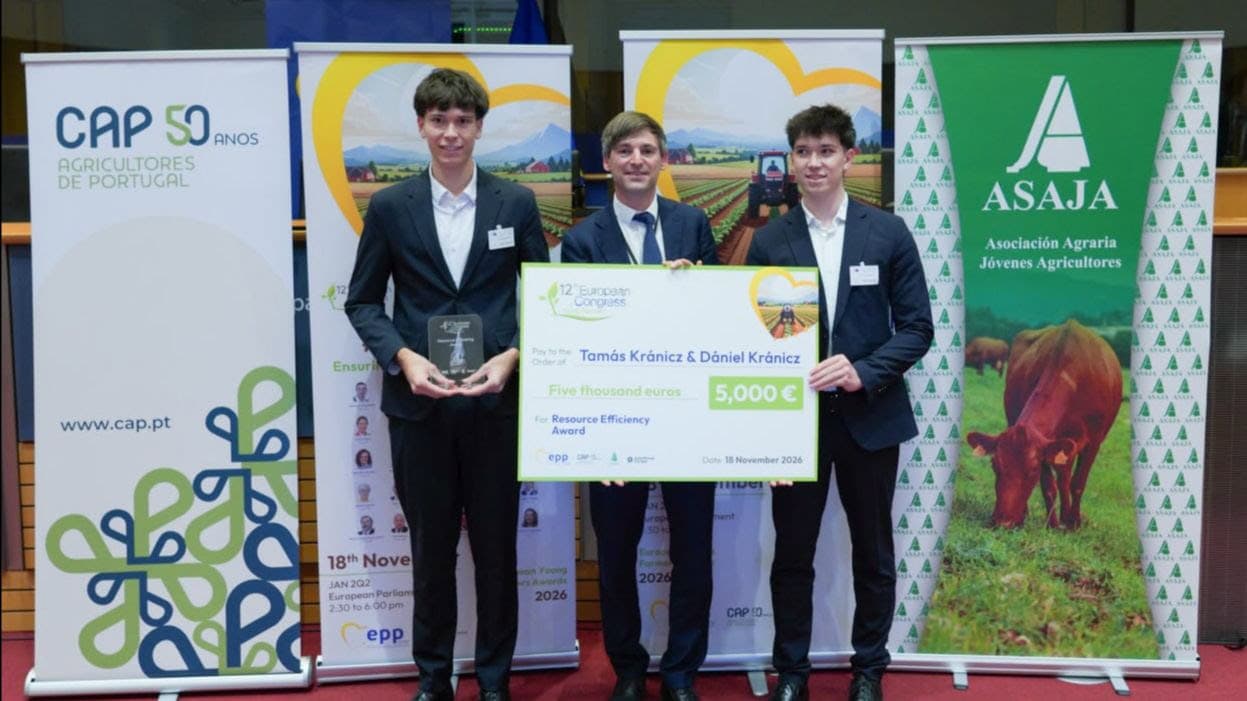
Tamás and Dániel Kránicz won the Resource Efficiency Award with “Microelectronic Waste in Winter Wheat and Popcorn”.
The brothers turn a copper-rich waste solution from printed circuit board manufacturing into a foliar fertiliser, tackling copper deficiency in Hungarian soils while giving crops natural protection against fungal disease.
In field trials near Győr since 2023, the treatment raised winter wheat yields and protein content and cut mycotoxin (DON) contamination by 31.5%, bringing grain below EU safety limits, at a cost of around €4 per hectare. The trials have since been extended to popcorn.
“This project is a remarkable example of innovation bringing two very different sectors together. By exploring how waste from electronics manufacturing can be transformed into valuable agricultural inputs, Tamás and Dániel are challenging the way we think about resources. Their research shows the potential of circular solutions to improve farming efficiency while reducing waste. Congratulations to both of them for bringing such a creative approach to one of agriculture’s biggest challenges!” said Dries Acke, Deputy CEO of SolarPower Europe.
Bernardo Vieira e Brito won the Digital Innovation in Agriculture Award with “Valle dos Três Irmãos”.
After a career in consulting, Bernardo returned to his family’s land in the North of Portugal in 2018 and built a diversified 24-hectare farm producing organic eggs and kiwifruit, DOC Vinho Verde wine, maize, lemons and honey. Soil and climate sensors, satellite maps, automated poultry houses, solar power with battery storage and everyday AI tools let a team of five run it all, cutting wasted irrigation water by 30–35% and replacing 90% of bought fertiliser with the farm’s own manure.
“Congratulations to Bernardo Vieira e Brito on this well-deserved award. This year’s projects are a great example of how farmers are turning digital innovation into practical solutions to real challenges,” said Olivier de Matos, Director General of CropLife Europe. “There is huge potential to take this further. Our sector is investing heavily in digital and precision agriculture, and a dedicated EU strategy for digital agriculture can help create the conditions for these technologies to reach more farmers and deliver at scale.”
Christian Rabensteiner won the Farm Diversification & Business Innovation Award with “Naked Funghi”.
With dairy farming alone no longer enough to support the family farm in South Tyrol’s Sarntal valley, Christian founded Naked Funghi in 2023, growing organic mushrooms year-round in four converted shipping containers powered by solar energy. He makes his own substrate from local by-products, including pine oil mash from the valley, sells fresh, dried and supplement products directly to restaurants, shops and households, and returns the used substrate to the fields as fertiliser.
“Christian’s project captures what the Farm Diversification & Business Innovation Award is about: entrepreneurship, innovation and sustainability creating new opportunities and rethinking traditional business models. McDonald’s sources 95% of our key agricultural ingredients for the EU from within Europe – so we celebrate projects like Christian’s, which help make farming a more innovative, resilient and attractive choice for the next generation.” said Anna Borys, Senior Director Government Relations Europe at McDonald’s
The EPP European Congress of Young Farmers was launched in 2012 by Members of the EPP Group, together with the Confederation of Portuguese Farmers (CAP) and ASAJA. Each year it brings young farmers from across Europe to the European Parliament to share their experiences, present their projects and discuss the future of farming with EU decisionmakers.
The 2026 edition was supported by SolarPower Europe, CropLife Europe and McDonald’s.
- photo credit: euyoungfarmers.eu/Buscardini Communications