







Mention the Netherlands to most folk and they might think of windmills, tulips and bicycles.
It does roughly have 1,200 historic windmills, is the world’s largest producer and exporter of tulips and the number of bicycles actually outnumbers its 18.5m population.
It’s also a fact that Amsterdam remains one of the world’s most popular cities. It ranks around 23rd to 25th globally in overall visitor numbers and roughly 7th in Europe, according to international tourism rankings.
It seems hard to imagine that, as recently as 2004, it launched a campaign to attract visitors.
Fast forward to 2026 and the pendulum has swung full circle and the city, like some others in Europe, is seeing a renewed tourism boom. But this begs the question: can cities like Amsterdam cope with it all?
Governments have introduced a tourism tax to offset the public costs and environmental strain caused by high volumes of visitors and Amsterdam is set to impose nearly the highest tourist tax in the world. The drastic tax hike is key to the Dutch government’s strategy to curb over tourism.
Amsterdam’s municipal overnight tourist tax, which sits at a European-high 12.5%, will be raised incrementally over the coming years.
The city has a strict, self-imposed target cap of 20 million overnight stays per year, which has been consistently exceeded and tens of thousands still flock to the city in the so-called low season (October and November), reflecting its perennial, year-round appeal.
Why go now?
Well, this is a city worth visiting any time of year but the autumn is especially nice because there are, indeed, slightly fewer tourists than other times of the year.
That means things like hotel prices might be that bit lower now (as well as queues for all its many canal boat trips).
The city authorities are also currently trying, again, to refocus their tourist strategy, namely addressing the many hen and stag parties that descend here throughout the year.
They want the focus to be, less on its (in)famous red light district, and more on the countless and rich cultural offerings (it has, for instance, one of the highest concentrations of museums in the world relative to its size and population).
The city also just celebrated its 750th birthday (2025, in fact) so, albeit belatedly, it’s still time to “join in” the celebrations of a city that may number only 800,000 inhabitants but boasts no less than 180 different nationalities.
Where to stay
One company that is buying into the targeted tourism philosophy is Wilde, a leading Irish-based accommodation provider which has just added Amsterdam to its ever-growing portfolio.
The key difference to its brand new Dutch location – it opened in Amsterdam less than a month ago – is that guests must stay a minimum of seven nights.
This is, not least, to encourage longer-term stays to the city as opposed to the quick, whistlestop visits from passing cruiser ships, Americans ticking off a box (or those aforementioned party groups).
The new accommodation is located just over the river IJ from Central Station (accessible via a free ferry) in Amsterdam Noord, once the city’s industrial hub but now being totally transformed.
The building occupies the first eight floors of a 30-floor block (the other floors are residential) and comprises a range of well appointed, comfortable self-contained apartments, including studio, one and two-bed apartments. Amenities include a kitchenette, TV, free wi-fi and a balcony affording great views over the river. A breakfast of freshly-baked croissants and coffee is also available. Following recent successful debuts in Lisbon and Vienna, Wilde’s continued European expansion (in Amsterdam and Porto) reflects the brand’s commitment to celebrating local culture – with a twist of Irish charm. Wilde’s MD Kelly Morgan says, “These openings allow us to continue our mission of delivering a home-away-from-home experience where the flexibility of apartment-style living is integrated with the elevated service of a boutique hotel.”
This terrific aparthotel also boasts a 3rd floor garden/terrace, 24-hour reception, on-site parking, co-working spaces and a small gym. There is also a pleasantly decorated and a comfy lounge area (decor courtesy of Dutch artist Lisette van Hoogenhuyze) where you can relax with a drink or enjoy a snack or light meal from a menu appropriately called “Oscar Wilde” after the famous Irish author and writer (who also gives his name to the business). The mostly young staff, headed by GM Rob De Ridder, are also very friendly and helpful.
Its location is ideal: you are tucked away from the noise of Amsterdam’s millions of tourists but, at the same time, just a quick, 3 minute ferry ride away from all the city’s attractions. This is a real go-ahead, forward-thinking company (part of the Staycity Group) that has come on leaps and bounds since its launch a few short years back but it is important to remember that, at Amsterdam, it accepts bookings for a minimum stay of 7 consecutive nights be that for leisure or business-related travel.
What to do
There is so much it’s hard to know where to start in Amsterdam but a visit to at least a couple of its “Holy Trinity” of world-famous museums is as good a place as any.
Arguably the most famous is the Anne Frank Museum which is a small museum with limited space and tickets sell out quickly.It is best to book tickets as soon as possible, six weeks in advance. Every Tuesday morning between 10-11am CET and a small number of tickets are released for the following week.
The museum is the authentic canal-side building where the courageous Anne Frank and seven other people hid in a cramped secret annex during World War II. Visitors walk behind the original hinged bookcase to explore the preserved, unfurnished rooms where the family lived in silence for over two years. On display are Anne’s original red-checked diary, personal notebooks, family photographs, and pencil marks on the wall tracking her growth.
The exhibition contextualizes Anne’s life within the systematic persecution of European Jews under Nazi occupation.
Another absolutely must-see-visit place to visit is the Van Gogh Museum,located in the city’s museum quarter and home to the largest collection of work by the artist in the world, including over 200 of his paintings,500 drawings and more than 750 letters. The marvellous museum guides you through the artist’s life in sequence. Given that this place has been the target of major art heists twice (in 1991 and 2002) just be grateful to observe the great man’s wonderful work up close and personal.
Just round the corner from the Wilde site, is something quite different, “This is Holland”, which consists of two informative shows about the Netherlands and a 9-minute, 5D flight simulation with wind & water effects over Holland’s famous sights including its tulip fields, those famous Amsterdam canals and the bustling harbour of Rotterdam. It is great fun.
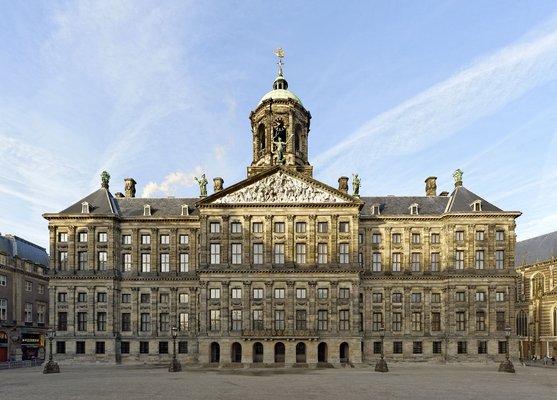
Just over the river and close to Dam Square, possibly the heart of the city, is the Royal Palace, which has a real Belgian connection in the shape of one Artus Quellinus, a Flemish sculptor who is regarded as the most important representative of the Baroque in sculpture in the Southern Netherlands. Some of his best works are in the Palace which is open to the public much of the year and also features artworks by Dutch masters.
There is also a strong UK link: The Bedroom of the English Quarter, a historic private chamber reserved exclusively for visiting heads of state and royal guests, including Belgium’s King Philippe and Queen Mathilde on a 2016 state visit. The palace has the most famous balcony in the country and it was from here that Winston Churchill was greeted by ecstatic crowds right after WW2.
On a similar theme, the Resistance Museum, meanwhile, is another place you should see while in this lovely city. It tells the story of the 2nd World War through 130 personal, often tragic stories – people who faced difficult choices in extreme circumstances. It is very well laid out and, overall, a moving experience and also a rather timely reminder about the dangers posed by (current day) dictatorships.
On a lighter note, check out yet another museum, the excellent Straat Museum (museum of street art), located a few minutes’ walk from the Wilde aparthotel. It has over 180 works by 170 artists, both well known international artists and new talent.
Of course, while in Amsterdam you can see, at least the outside, of some of these places and many more by taking a boat trip on some of its 165 canals.
Amsterdam Boat Adventures offers a highly informative 90-minute “old city centre” cruise.It keeps its tours small, with a maximum of 12 guests and the route is a great mix of famous sights, smaller canals and a few hidden gems along the way.
Another highly recommended canal trip is with the imaginatively named “Those Dam Boat Guys”, whose focus is on making the trip a relaxing, casual and fun experience. Try to ask for Andy, a 61-year-old Brit who’s lived in the Netherlands for nearly 40 years and is very entertaining and informative about his adopted home and city.
Both these companies are definitely among the best way to experience the city some of the 17th century canal ring, a UNESCO World Heritage Site. It’s from such a vantage point you hear about those strange, leaning buildings in the city, the city’s 16 lock systems (that prevent potential flooding), why one public square is named after the Battle of Waterloo, why the average price of a house boat here is an eye-catching €1m and, naturally, the origins of the name Amsterdam.
Where to eat
According to business data there are 2,929 restaurants in Amsterdam as of April 2026.
So, where to start when considering great places to dine?
Well, Amsterdam is called the Venice of the North so if a spot of really delicious Italian cuisine is your thing then there is one (very new) you really must head for.
PepeNero, a genuinely authentic Italian resto (one of two belonging to the same group in the city) that combines quality, warm hospitality, stylish surroundings and an eye for detail.
Fish is the speciality here which should not be a surprise when you consider that the owner/head chef is from Naples,less than 1km from the shoreline.
It’s especially well cooked here and is prepared to your own preference: salt-baked (most popular method with customers) or oven cooked.
The dishes, generally, might be best characterized as classic Italian with a focus, yes, on southern Italian cuisine (all the staff are of Italian descent, including the helpful Sardinian-born Enrico who happily explains the card and its contents to diners).
Many locals in this city are already fully aware of the well-earned high reputation enjoyed by PepeNero but this second resto (located on Linnaeusstraat, just outside the centre) is very new (since Apri) and the expectation is that word will soon spread among both locals and tourists alike as to the sheer quality of its cuisine.
This magnificent resto can seat about 70, boasts an open kitchen, where you can observe some very highly skilled culinary talent at first hand, and is curiously housed in what once used to be a hospital.
As such you can safely say this fantastic resto provides just the “tonic” you might need after a day spent traipsing around Amsterdam.
Another equally and really terrific place to eat, located just over the river, is “Cafe Modern” whose relatively modest appearance (a 5-minute walk from Wilde) and décor slightly belies some truly wonderful food.
It also employs a slightly novel approach to eating out… you do not actually know what will appear on your plate.
This is how it works: you choose the number of dishes you want (5,6 or 7) and that is about it. The actual choice of dishes remains up to the chef and market availability on any given day. In other words, all the hard work (such as it is) involved in trying to decide what to pick on the menu is all done for you. What’s not to like?
The good news is that, irrespective of quantity, you can be sure that the quality will be totally top notch.
The 6 course option, for example, might include salt-cured perch, celeriac soup, scallop, croupedine beetroot, dry-brined farmed duck and, to finish, warm chocolate mouse. Delicious and, considering the quality, all reasonably priced.
You dine in informal, relaxed surroundings that can seat up to 60 and there is a healthy mix of both locals and tourists.
This quite marvellous place was once a bank (the vault has been converted into a private dining area) and you will certainly not been short changed if you eat here.
Summary
What’s not to like about this free-spirited and eclectic city, located just 35 minutes from Schiphol airport?
Judged by the sheer volume of visitors who flock here throughout the year and despite the current energy crisis, it is sure to cement its position as one of the world’s fave city destinations.
Clearly, that in itself is causing certain problems with, possibly, the main issue caused by overtourism being the unsustainable degradation of local communities’ quality of life.
But such issues are, essentially, best left to lawmakers and law making. For now, this particular Dutch master is hard to beat.
Top tip: try to visit for its annual “star turn” – the Tulip festival which runs from March 18 to May 9, 2027 (just a 30 minute drive from Amsterdam).
Further info:
https://www.thisisholland.com/
https://www.vangoghmuseum.nl/nl
https://www.verzetsmuseum.org/
https://www.paleisamsterdam.nl/
https://www.amsterdamboatadventures.com/
https://www.amsterdamboatadventures.com/
https://www.straatmuseum.com/
- Photo Copyright: Royal Palace Amsterdam